TAD-GS: Temporally Aware Densification for Dynamic 3D Gaussian Splatting

ECCV 2026
Indian Institute of Science, Bengaluru, India

Existing 3DGS densification fails to refine short-lived dynamic Gaussians, resulting in blurry reconstructions. TAD-GS recovers highly dynamic regions. Move the cursor over video to compare.

Abstract

Despite modeling temporal motion, dynamic 3D Gaussian Splatting (3DGS) methods still inherit a static densification strategy ill-suited for dynamic scenes. This neglect of temporal behavior leads to under-reconstructed and blurry dynamic regions, as short-lived Gaussians receive sparse supervision and fail to densify effectively.

We propose a Visibility-Aware Densification (VAD) framework that integrates temporal visibility into the densification process, ensuring that Gaussians are refined based on their actual temporal presence. A Temporally-Adaptive Thresholding (TAT) mechanism further adjusts each Gaussian’s densification threshold according to its temporal lifespan, promoting balanced refinement of both static and dynamic regions. Finally, a Temporal Offset Warping (TOW) design enhances deformation capacity around temporal centers, extending the lifespan of highly dynamic Gaussians and facilitating more effective densification.

Our approach achieves substantial improvements in the visual quality of dynamic regions, outperforming existing methods across three dynamic multi-view benchmark datasets. Moreover, the proposed VAD module generalizes across diverse dynamic 3DGS methods, consistently improving dynamic reconstruction as a plug-and-play component.

Method Overview
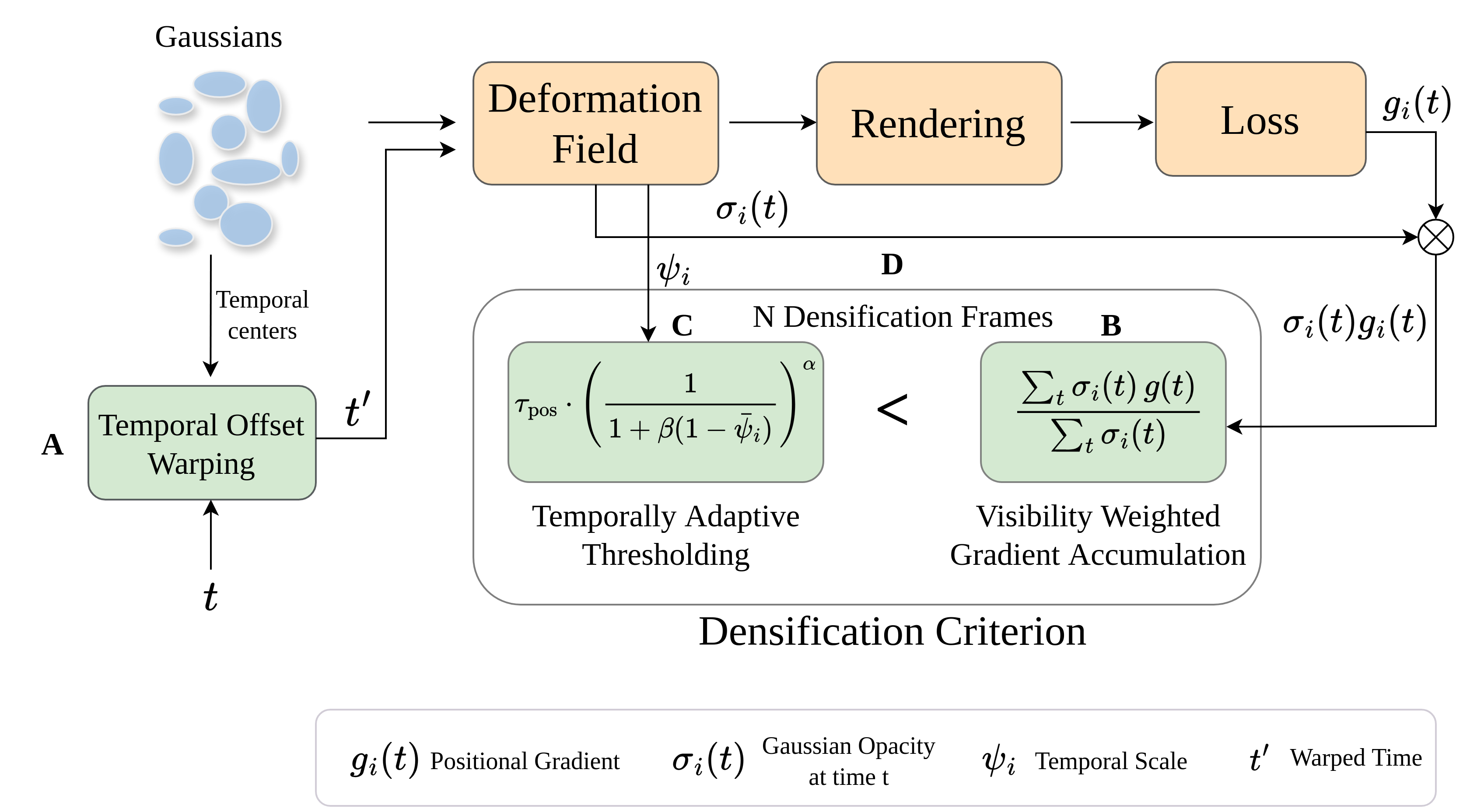
TAD-GS method overview diagram
Overview of our proposed densification framework. (A) Temporal Offset Warping adaptively warps the input time around each Gaussian's temporal center, stretching regions near the center and compressing those farther away. (B) We accumulate the visibility weighted gradient signal for the N densification frames. (C) We dynamically adjust the densification threshold based on temporal scale ψ averaged over the N densification frames. (D) A Gaussian is densified when its visibility-weighted gradient accumulation exceeds the temporally adaptive threshold.

Results

Comparisons

TAD-GS consistently produces sharper reconstructions of dynamic regions compared to existing methods.

Generalization of VAD

The plug-and-play VAD module consistently improves dynamic reconstruction across existing baselines.

BibTeX

@article{sandu2026tadgs,
  author    = {Sandu, Vikram and Pathak, Mayurdeep and Soundararajan, Rajiv},
  title     = {Temporally Aware Densification for Dynamic 3D Gaussian Splatting},
  journal   = {ECCV},
  year      = {2026},
}

References